Keep Victoria Falls Wild
Conservation and Development of the Victoria Falls
An 'Eye Opener' (February 2022)
Reactive Report
Radisson Blu Resort
Nothing to Report (2024)
Committee Clarifications (2024)
Analysis and Conclusions (2024)
Decisions Adopted (2024)
The following text has been adapted (with permission) from
researched and written by Peter Roberts and published in February 2026
In the Spotlight
Monitoring Mission (2022)
A UNESCO led Reactive Monitoring Mission to the Falls, originally requested by in 2019 in response to growing tourism development pressures and delayed by the global pandemic, took place in February 2022. The objective of the mission was summarized as being to “assess the potential threat posed to the property’s OUV [Outstanding Universal Value] by the growing tourism development pressure in and around the property, the potential impacts of the Batoka Gorge Hydro Electric Scheme (BGHES), to review the regulations to control this pressure and to make recommendations to the Committee on the proposed boundary modification” (World Heritage Commission, 2023). Zambia National Commission Secretary General for UNESCO, Charles Ndakala, recorded at a meeting with tourism stakeholders in Victoria Falls (after similar meetings on the Zambian side):
“We were assessing as mandated to check the effects of developments on the World Heritage site. This also includes the planned Batoka project as we wanted to engage stakeholders to find out how it will affect tourism upstream. This process will result in a report that will be presented to superiors at the upcoming UNESCO World Heritage Convention in June. The report will determine whether Victoria Falls continues as a listed World Heritage Site or it gets downgraded which is also called red-listing, or is totally removed from the list.” (Victoria Falls Bits and Blogs, 27th March 2022)
An 'Eye Opener' (February 2022)
Media reports at the time of the visit indicated local tourism stakeholders were committed to upholding the protected area of the Site.
"Stakeholders in the tourism industry have vowed to keep the iconic Victoria Falls in its pristine state as a World Heritage Site to protect the destination’s status.
"This comes as the United Nations Educational, Scientific and Cultural Organisation (Unesco) has deployed a team to assess the state of the destination and its environment in the wake of massive human developments that have taken place since it was declared a World Heritage Site in December 1989...
"The assessment will determine whether Victoria Falls continues as a listed World Heritage site, gets downgraded or red-listing, or is totally removed from the list...
"Environment, Climate, Tourism and Hospitality Industry deputy director (natural resources) Mr Tanyaradzwa Mundoga, who represented the ministry, said the industry is committed to balancing between development and conservation...
"'The team was sent to assess the potential impact of the threats since there are certain parameters to be followed in terms of the need to preserve tourism and value of the product,' he said...
"'We assured the team that we are going to balance development and conservation and will not allow anything that will jeopardise the pristine nature of the heritage site.'...
A local resident, Mr Trevor Lane, was quoted in media reports indicating participation in the engagements over the mission:
"Mr Trevor Lane said the engagements have been an eye opener to the industry and conservationists. He said any developments should ensure they stick to guidelines and not disturb the natural habitat while balancing between tourism and conservation." (Victoria Falls Bits and Blogs, 17th February 2022)
Ironic words from a man directly involved in subsequent and controversial development of the Baines Resturant within the World Heritage Site 'Highly Ecologically Sensitive' no new development area.
Reactive Report (2022/3)
The UNESCO Reactive Monitoring Mission report, due to be presented to the June 2022 meeting of the World Heritage Committee, warned that the Victoria Falls World Heritage Site “is facing increasing threats from individual and cumulative infrastructure developments” and concludes that the Outstanding Universal Values for which the Falls are globally recognised could be considered to be in danger if current development proposals - most notably the Zambian Mosi-oa-Tunya Resort development - proceed without the appropriate level of consideration for the environment (World Heritage Commission, 2023).
The report follows a UNESCO Reactive Monitoring Mission to the site, first requested in 2019 following concerns over tourism and other development pressures at the site, but delayed until February 2022 by the global pandemic.
Presentation of the Report was delayed as the meeting was planned to be held in Russia but was postponed at the last minute due to the Russian invasion of Ukraine. The draft report, which had been circulated to Zambia and Zimbabwe for information, resulted in widespread critical national, regional and international press and media coverage (The Times, 16th July 2022). The final report was not published until June 2023.
The report highlights several areas of concern relating to the north bank Mosi-oa-Tunya Resort development, including identifying concerns relating to apparent infringements of the development conditions approved by the Zambian Environmental Management Agency (ZEMA). The report concludes that the developers have failed to comply with several of the conditions of approval for the construction and that ZEMA should consider the suspension of their approval of the project until the identified concerns are resolved.
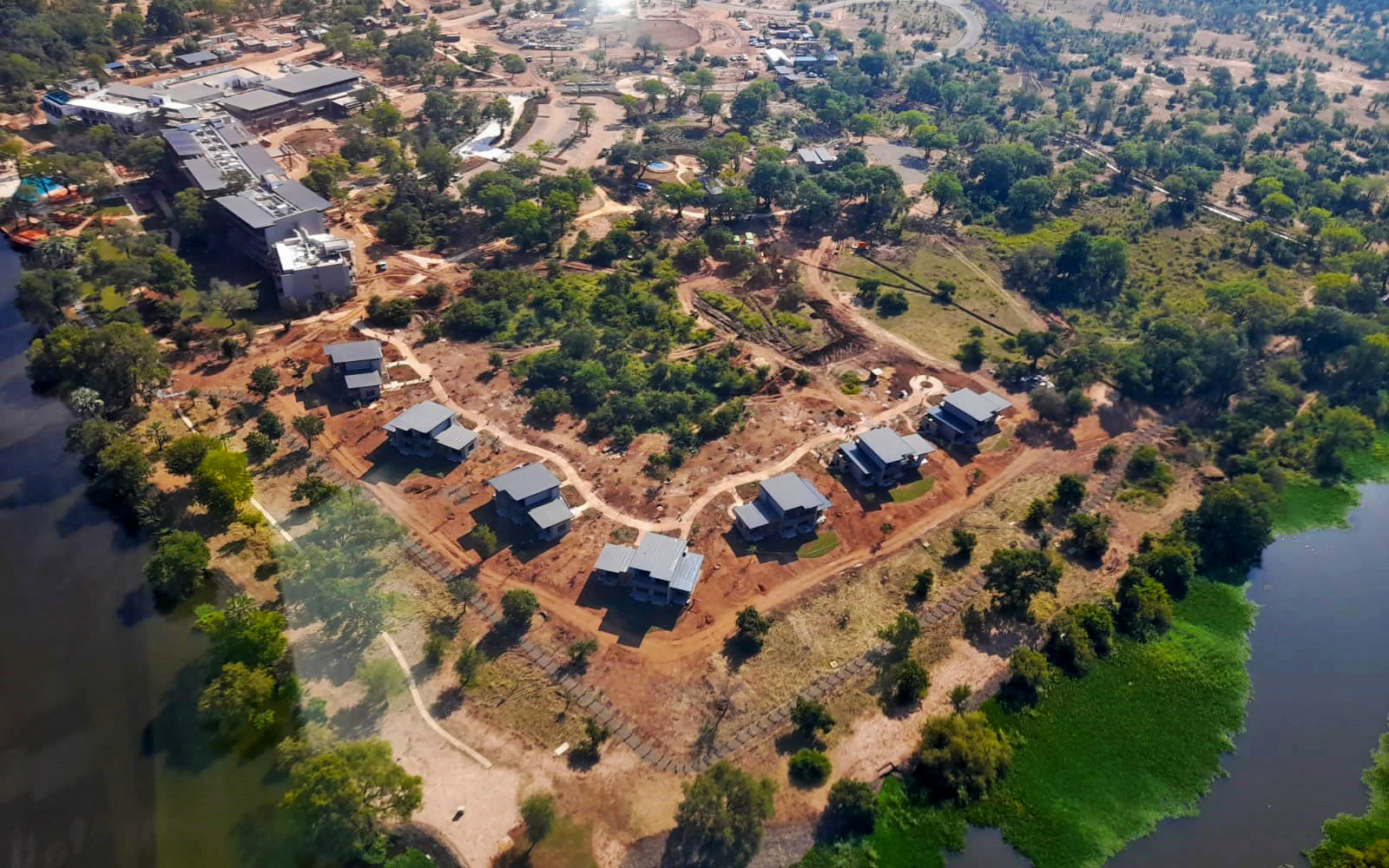
Mosi-oa-Tunya Resort Development, July 2022
The report also highlighted concerns over tourism developments impacting the river corridor, especially in the upstream section of the site, the report of the Reactive Monitoring Mission concluding:
“For the area upstream from the Falls, the mission observed that the rationale for the 1989 recommendation to focus on the riverine strip of the National Parks remains justified, with most pressure actually felt by the NP areas near the river that are most relevant to the integrity of the site. While MoTNP and ZNP have been identified as buffer zones, the tourism developments have shown that the status of National Park has not provided the envisaged protection.” (World Heritage Commission, 2023, p.22)
In June 2022 UNESCO approved a payment of US$25,100 to Zambia towards the ‘review and updating of the Joint Integrated Management Plan for the Site.
Read more: Keep Victoria Falls Wild - UNESCO Report Raises Concerns Over Controversial Zambian Hotel Development at Victoria Falls.
Radisson Blu Resort
In April 2021 Radisson Hotel Group, apparently unconcerned over the controversial history of the north bank Mosi-oa-Tunya Resort, announced that it had secured the rights to operate the management of the new hotel, to be branded Radisson Blu Resort Mosi-oa-Tunya (Victoria Falls Bits and Blogs, 15th April 2021).
The Radisson Blu Mosi-oa-Tunya Resort opened in December 2022 (Victoria Falls Bits and Blogs, 20th December 2022).
Nothing to Report (2024)
Despite the wave of tourism developments surrounding and even within the World Heritage Site, the 2024 State of Conservation report for the Mosi-oa-Tunya/Victoria Falls World Heritage Site (State Parties, 2024), submitted to UNESCO under the signatures of Dr Mangwanya, Director General, Zimbabwe Parks and Wildlife Management Authority and Mr Ndiyoi, Acting Executive Director, National Heritage Conservation Commission (Zambia) and covering the period 2022-2023, presented no information on new or proposed developments affecting the Site or surrounding Buffer Zone, and failing again to notify the World Heritage Committee of the construction of the Baines Restaurant, National Park ‘Rock Pool’ development or launch of tours to Cataract Island among many other proposed new developments (Keep Victoria Falls Wild, July 2024).
Committee Clarifications (2024)
At the 46th World Heritage Committee Conference (46COM), held in New Delhi, India in July 2024, UNESCO highlighted increasing concerns over development pressures affecting the World Heritage Site, including the proposed Batoka Gorge Hydro-Electric Scheme and increasing tourism development pressures.
“On 2nd February 2024, the State Parties of Zambia and Zimbabwe submitted a state of conservation report for the property... reporting the following:
“The State Parties commit to ensuring that the revision of the Environmental and Social Impact Assessment (ESIA) for the Batoka Gorge Hydro Electric Scheme (BGHES) is in line with the Guidance and Toolkit for Impact Assessments in a World Heritage Context, stakeholders are being engaged in mobilizing resources to conduct the recommended studies including the geomorphological and/or geological assessments and a Sustainable Development Programme.
“Discussions with the World Heritage Centre regarding the potential hosting of a Conference on Sustainable Development, including to share ideas on how projects of the magnitude of BGHES could be implemented without negatively impacting the Outstanding Universal Value (OUV), are in progress. Further details will be disseminated to stakeholders by June 2024.
“The Joint Integrated Management Plan (JIMP) is being revised with International Assistance funding and co-financing by the State Parties, and expected to be finalized by June 2024.
“The implementation of mitigation measures for the Mosi-oa-Tunya Livingstone Resort Hotel as part of legal conditions of approval issued by the Zambian Environmental Management Authority (ZEMA) and contained in the JIMP, is ongoing. The process to revise the ESIA has been initiated including the development of a comprehensive Environmental and Social Management Plan (ESMP).
“The requested boundary modification will be submitted.
“The State Parties take note of the Committee’s request to seek early inputs and technical guidance from IUCN in undertaking the second phase of the Strategic Environmental Assessment (SEA) on cumulative development and environmental pressure on the property...
“The State Parties endeavour to implement all the recommendations from the 2022 joint World Heritage Centre/IUCN Reactive Monitoring Mission;
“The 10-year (2023-2033) General Management Plans for the Zimbabwean components of the property have been completed...
“A number of developments have been proposed to be undertaken within the property and its Buffer Zone, which are mostly at the scoping stage and, as required by environmental laws and the World Heritage Convention, have to undergo an Environmental and Heritage Impact Assessment process (EHIA); these developments are not specified in the report.
“On 16th April 2024 the State Parties transmitted to the World Heritage Centre, an interim report on the progress of review of the JIMP, also highlighting their progress on the review of the zonation of the property.” (UNESCO, 2024)
Analysis and Conclusions
In its analysis and conclusions the report highlighted 'significant' development pressures.
“The continued cooperation between the State Parties and their partners to improve the State of Conservation of the property is appreciated, as is the ongoing research, monitoring and management activities that have been reported. The proposed conference on Sustainable Development may further strengthen these efforts.
“The property continues to face significant development pressure from both individual and cumulative infrastructure projects. In this context, it is recommended that the Committee urge the State Parties to expedite the SEA on the cumulative development and environmental pressure on the property, seeking inputs and technical guidance from IUCN.
“In March 2024, several news outlets reported plans by the State Parties to retender the BGHES by April 2025, with new potential developers expected by September of the same year. The commitment of the State Parties to revise the ESIA for BGHES in line with the Guidance and Toolkit for Impact Assessments in a World Heritage Context is noted, and this revised ESIA should be submitted to the World Heritage Centre before taking any decisions that may be difficult to reverse. As recommended by the 2022 Reactive Monitoring Mission, the ESIA should ensure an assessment of alternative scenarios to avoid negative impact on the OUV of the property."
The Committee repeated its 2023 request for mitigation measures regarding the Mosi-oa-Tunya Resort development in Zambia.
“Regarding tourism infrastructure development, recalling that the Mosi-oa-Tunya Livingstone Resort Hotel was constructed despite the Committee’s request to halt further activities, details on the implementation of mitigation measures should be provided, ensuring that the infrastructure does not negatively impact the OUV of the property. It is regrettable that the State Party of Zimbabwe has still not provided a response to the third-party concerns transmitted in 2023 regarding a permit for two commercial tourism developments within areas of the property that are recognized as highly sensitive zones according to the previous JIMP (Cataract Island and its adjacent riverine rainforest area). Further information is also required on the developments proposed in the property and buffer zone that are currently under scoping stage and will require impact assessments; these projects should not proceed without the World Heritage Centre having been informed and the impact assessments concluded for review by the Advisory bodies.
“Cumulative impacts from tourism infrastructure developments remain a concern for the protection of the OUV of the property and it is therefore important to emphasize again the need to ensure that any project proposal within, in the buffer zone, or in the wider setting of the property undergoes an ESIA in accordance with the Guidance and Toolkit for Impact Assessments in a World Heritage Context, and to urgently conclude the SEA and implement the 2022 Reactive Monitoring mission recommendation to develop a blueprint for infrastructure development in and around the property to guide strategic level planning.
“In this regard, recalling the concerns over increasing pressure from tourism infrastructure within and around the property, exacerbated by the absence of strategic planning, the reported progress and planned completion of the updated JIMP for the property by June 2024 is acknowledged. As requested by the Committee (Decision 45 COM 7B.10 [2023]), the updated JIMP should incorporate the necessary safeguards and thresholds to mitigate against development pressures for the protection of the property’s OUV, and it is recommended that the updated JIMP be submitted to the World Heritage Centre for review by IUCN prior to its adoption. It is positive that the 2023-2033 GMPs for the Zimbabwean components of the property have been completed, which should ensure full alignment with the updated JIMP.
“The State Parties’ confirmation that a boundary modification request will be submitted is noted. Recalling that inconsistent boundary maps have been utilized to date, the update of the JIMP is an opportunity to review the boundary, zonation and buffer zones, aiming to enhance the protection of the OUV of the property and aligning the JIMP with past Committee Decisions and the property’s Statement of OUV.” (UNESCO, 2024)
Decisions Adopted
The Committee placed further pressure on the State Parties to adequately address these concerns in the new Joint Integrated Management Plan for the Site which was due for submission by end of June 2024 but now delayed until June 2025:
“Appreciates the continuous cooperation between the State Parties and their partners to improve the state of conservation of the property, and to conduct the reported research, monitoring and management activities;
“Urges the State Parties to expedite the Strategic Environmental Assessment (SEA) on the cumulative development and environmental pressure on the property, seeking inputs and technical guidance from IUCN, and to conclude full implementation of the 2022 Reactive Monitoring mission recommendations;
“Also recalling its concern regarding the increasing pressure from tourism infrastructure within and around the property, exacerbated by insufficient implementation of strategic planning, acknowledges that the revision of the Joint Integrated Management Plan (JIMP) for the property has been delayed for the purposes of alignment with other respective national documents, and requests the State Parties to:
a) Finalize the JIMP as soon as possible and to ensure that it incorporates necessary safeguards and thresholds to mitigate against developmental pressures for the protection of the property’s OUV, and zonation of the property, including well prescribed limits of use and permissible activities (including infrastructure), in line with the objectives of protecting the OUV and with past Committee decisions,
b) Set precise boundaries of the property and its buffer zone in view of concluding the Retrospective Inventory for the property,
c) Report on the harmonization of various national and transboundary plans and policy documents, and
d) Submit the JIMP to the World Heritage Centre by 30th June 2025 for review by IUCN before it is adopted.
“Noting again with concern the likely negative impacts of the proposed Batoka Gorge Hydro Electric Scheme (BGHES) on the Outstanding Universal Value (OUV) of the property, also takes note that the State Parties will revise the Environmental and Social Impact Assessment (ESIA) in line with the Guidance and Toolkit for Impact Assessments in a World Heritage Context, and requests the State Parties to ensure that the revised ESIA includes alternative scenarios to avoid impact on the OUV of the property, and to submit the revised ESIA to the World Heritage Centre for review by IUCN prior to taking any decision that is difficult to reverse.
“Recalls with regret that the construction of the Mosi-oa-Tunya Livingstone Resort Hotel was concluded despite the Committee’s request to halt further activities until the ESIA had been submitted to the World Heritage Centre and reviewed by IUCN, notes that the mitigation measures integral to legal conditions of approval issued by Zambian Environmental Management Authority are being implemented, and also requests the State Parties to provide further details on the implementation of these mitigation measures to ensure that the infrastructure does not negatively affect the OUV of the property.
The agreed delay in the submission of the new JIMP document effectively avoided any review or discussion on the management of the Site at the 47th session of the World Heritage Committee, held in Paris over 6th-16th July 2025.
The Committee specifically repeated requests for full disclosure of developments in and around the Site and thorough Environmental and Social Impact Assessments to be undertaken, and submitted to the Committee, before being authorised.
“Further requests the State Parties to provide information on all developments proposed in the property, its Buffer Zone, and wider setting, including on a permit for two commercial tourism development sites within the Zimbabwean component of the property recognised as highly sensitive zones according to the previous JIMP, and also urges the State Parties to ensure that any project proposals that may impact the OUV undergo an ESIA in accordance with the Guidance and Toolkit for Impact Assessments in a World Heritage Context before taking any decision that is difficult to reverse.
“Further takes note of the State Parties’ confirmation to submit a request for boundary modification.
“Finally requests the State Parties to submit to the World Heritage Centre, by 1st December 2025, a joint updated report on the State of Conservation of the property and the implementation of the above, for examination by the World Heritage Committee at its 48th session.” (World Heritage Committee, 2024)
Authorities are due to submit an updated Joint Integrated Management Plan for the site in mid-2025 and an updated State of Conservation Report in early December 2025 ahead of the 48th session of the World Heritage Committee, due to be held in July 2026.
Next: Controversial Concessions
References
Links to external sites or pdf downloads, open in a new window.
Keep Victoria Falls Wild (July 2024) State of Development Report 2024.
Roberts, P. (2025) Footsteps Through Time - A History of Travel and Tourism to the Victoria Falls. Second Edition. Zambezi Book Company / CreateSpace Independent Publishing. (First published 2017, fourth edition July 2025).
Roberts, P. (2026) Paradise Lost? Conservation and Development of the Victoria Falls (1900-2025). First Edition, February 2026. Zambezi Book Company / CreateSpace Independent Publishing.
State Parties (2024) State of Conservation Report. Victoria Falls/Mosi-oa-Tunya World Heritage Site. February 2024.
The Times (16th July 2022) Golf and hotel could cost Victoria Falls its heritage status.
UNESCO (2024) Conservation Issues, Analysis and Conclusions [Online source:
https://whc.unesco.org/en/soc/4639]
Victoria Falls Bits and Blogs (17th February 2022) Unesco assesses Victoria Falls tourism destination.
Victoria Falls Bits and Blogs (27th March 2022) Victoria Falls World Heritage Status Hangs in Balance.
World Heritage Commission (2023) Joint Mission Report Mosi-oa-Tunya, Victoria
Falls (Zambia/ Zimbabwe) 9th-13th February 2022.
World Heritage Committee (2024) Decisions Adopted, 46COM 7B.60 [Online
source: https://whc.unesco.org/en/decisions/8586]