Keep Victoria Falls Wild
Existing Developments
Mosi-oa-Tunya National Park (Zambia)
Victoria Falls Power Station
Victoria Falls Power Station (1938)
Wheel Deal Casts a Shadow (2020)
World Heritage Site Implcations
Boundary Infringements (2021)
Victoria Falls Power Station (1938)
The Chartered Company had originally sold the contract to develop the hydro-electric potential of the Zambezi at the Victoria Falls in 1901 as a key part of the initial plans to develop the region, but the project was not realised until the late 1930s. Located in the bend of the third and forth gorges, known as the Silent Pool, construction of the plant was begun in June 1936 by the Victoria Falls and Transvaal Power Company, thirty years after its initial floatation.
The Power Station was opened on 16th March 1938 by Sir Hubert Young, then Governor of Northern Rhodesia. The immediate scope of the scheme was to supply electricity to the neighbouring town of Livingstone, with power transmitted by underground cable, as well as serving the Falls Hotel and Railway Reserve on the south bank.
“At the request of the Government great care was taken to avoid spoiling the beauty of the Falls. The water inlet is some distance above the Falls and an underground pipe-line leads to the top of a gorge some distance below them. An overhead power cable was necessary in one place [to cross the gorge and serve the Hotel], but it was put as far from the Falls as possible and it will not be seen by tourists. Even in the dry season the quantity of water taken by the Power Station is negligible in comparison with the total flow over the Falls.” (Parsons, 1938)
During a period of excessive drought in the late 1940s it was reported that engineers were actively blasting rock from the river bed in order to divert additional flow to the power station.
“Denied water by a series of drought years near the source of the Zambesi (in the Belgian Congo), Dr David Livingstone’s famous Victoria Falls have been at their ‘lowest in living memory’ this African summer... Rhodesian engineers have for weeks been blasting the bed of the crocodile and hippo-inhabited river above the Falls to force a sufficient flow of water to turn the dynamos.” (The Sydney Sun, December 1949)
The Victoria Falls Electricity Board was established under the Victoria Falls Power Ordinance of No.21 1951 to operate the Power Station which initially supplied Livingstone and the local Railway Company facilities, including the south bank Victoria Falls Hotel.
The original capacity of 2 Megawatts (MW) was soon expanded to 8 MW, and further expanded in 1969 with the addition of six generators of 10 MW each (installed underground) and again in 1972 with an additional four units, increasing the total maximum capacity to 108 MW. The Falls Board was amalgamated to form the national Zambia Electricity Supply Corporation (ZESCO) in 1970.
"The first power station at the Victoria Falls was built on the Zambian side in 1936. Its capacity was more than doubled during the 1960's when additional off-take channels and turbines were installed. It now has two main off-take channels. and six turbines and can generate up to 108 MW. The offtakes are situated just upstream of the Rainforest car park on the Zambian side, and the water is led through channels to the turbines at the end of the third gorge. The ZESCO offices and housing complex are situated on the right hand side of the Livingstone Road.
The maximum water offtake to generate 108 MW is 117 cumecs, but in practice, 92.3 MW are generated during January to August requiring 101.5 cumecs water diversion, and during September to December '72.7 MW are generated requiring 80.0 cumecs. The electricity is conducted away in overhead high tension cables into the Zambian National Grid whilst a proportion of the electricity generated is exported to Zimbabwe and Botswana." (IUCN, 1996b)
The expansions and subsequent plant developments have significantly increased the infrastructure impacts both above and below the Falls, as well as increasing the volume of water diverted from the Eastern Cataract of the Falls.
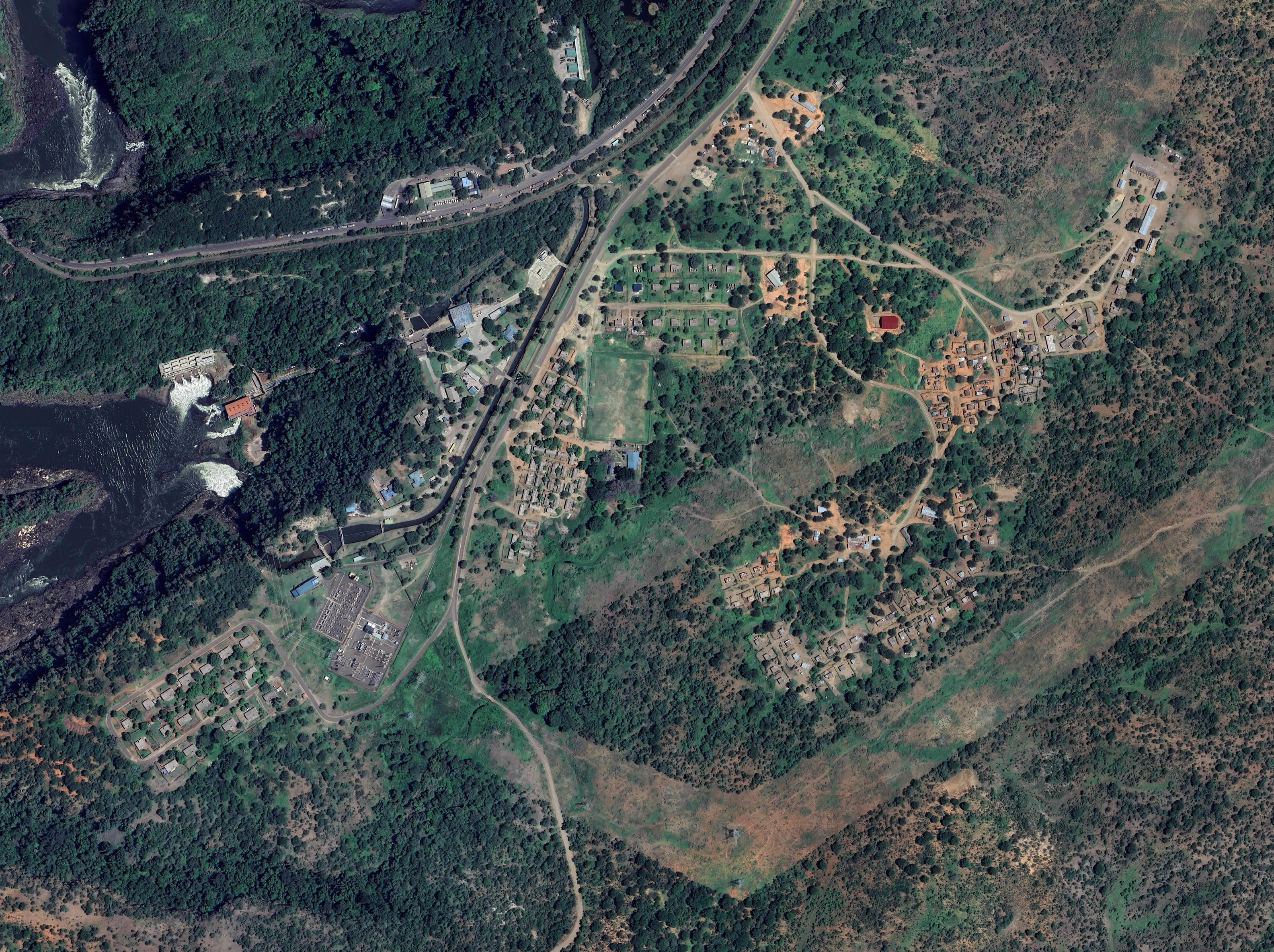
Above the station a growing administrative and staff accommodation area occupies a significant area within the National Park, on land owned by the national electric company ZESCO.
Wheel Deal Casts a Shadow (2020)
News reports from June 2020 indicated that ZESCO had sold land from within its infrastructure support site located close to the Falls hydro-electric power station and within the Mosi-oa-Tunya National Park and UNESCO World Heritage Site.
“ZESCO has sold land at the Victoria Falls to Chinese national Ju Wenbin for the construction of a Ferris Wheel... In January 2017 Chief Mukuni fought with success attempts by State House to offer Ju Wenbin the curio market at the Victoria Falls to erect a Spin-Sational Ferris Wheel. However, the National Heritage Conservation Commission (NHCC) has warned that the said land being within the Victoria Falls World Heritage Site (VFWHS) cannot have a construction of the proposed Ferris Wheel under UNESCO guidelines.” (Victoria Falls Bits and Blogs, 17th June 2020)
The 44th session of the UNESCO World Heritage Committee, originally planned for 2020 but postponed due to the pandemic, recorded:
“On 24th June 2020, the World Heritage Centre also requested comments from the State Party concerning the sale of land for construction of a Ferris wheel within the property. No specific response has been received from the State Parties in relation to the Ferris wheel proposal at the time writing.” (UNESCO, 2021)
The proposals appear to have subseqnetly been abandoned (see Observation Wheel proposal for full details).
The proposals highlighted the issues relating to the ZESCO controlled support area, located within the MTNP and area of the UNESCO WHS. As with the transport corridor running through the site, the land is outside the control of the National Park Authority and it is therefore unclear how the area is managed within the context of the WHS.
World Heritage Site Implcations
The extraction of water above the Eastern Cataract has resulted in significant reduction of flow over Eastern Cataract during low water periods, resulting in drying out of rainforest area at eastern end of Falls.
"The times of low flows are most critical from the viewpoint of the ecology of the rainforest and visual aspect of Victoria Falls: the situation is apparently exacerbated by the diversion of water for hydropower generation by ZESCO in the North Bank power station with the consequent drying up of the Eastern cataract at times of low flow." (IUCN, 1996b, p.26)
Boundary Infringements (2021)
The Strategic Environmental and Social Impact Assessment Report for the MOT/VF WHS (2021-2030) presented a map of the north bank MoTNP showing the 2006 boundary changes, pressures from human settlements bordering the park (and WHS), as well as highlighting areas of encroachment into the park. The map indicates that the issue of private land ownership within the area of the Maramba River, and overlapping into the park (and WHS) has yet to be resolved. The map also indicates a further area of encroachment surrounding the ZESCO facilities located above the junction of the third and forth gorges (State Parties, 2021, p.64).
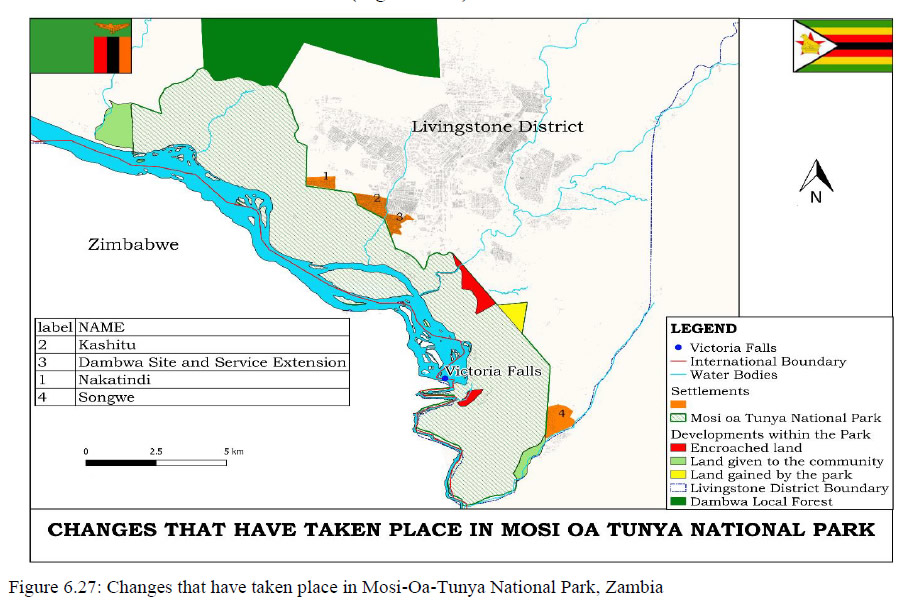
Map of MoTNP showing boundary pressures (areas of encroachment marked in red)
(State Parties, 2021, p.64) [click for larger view]
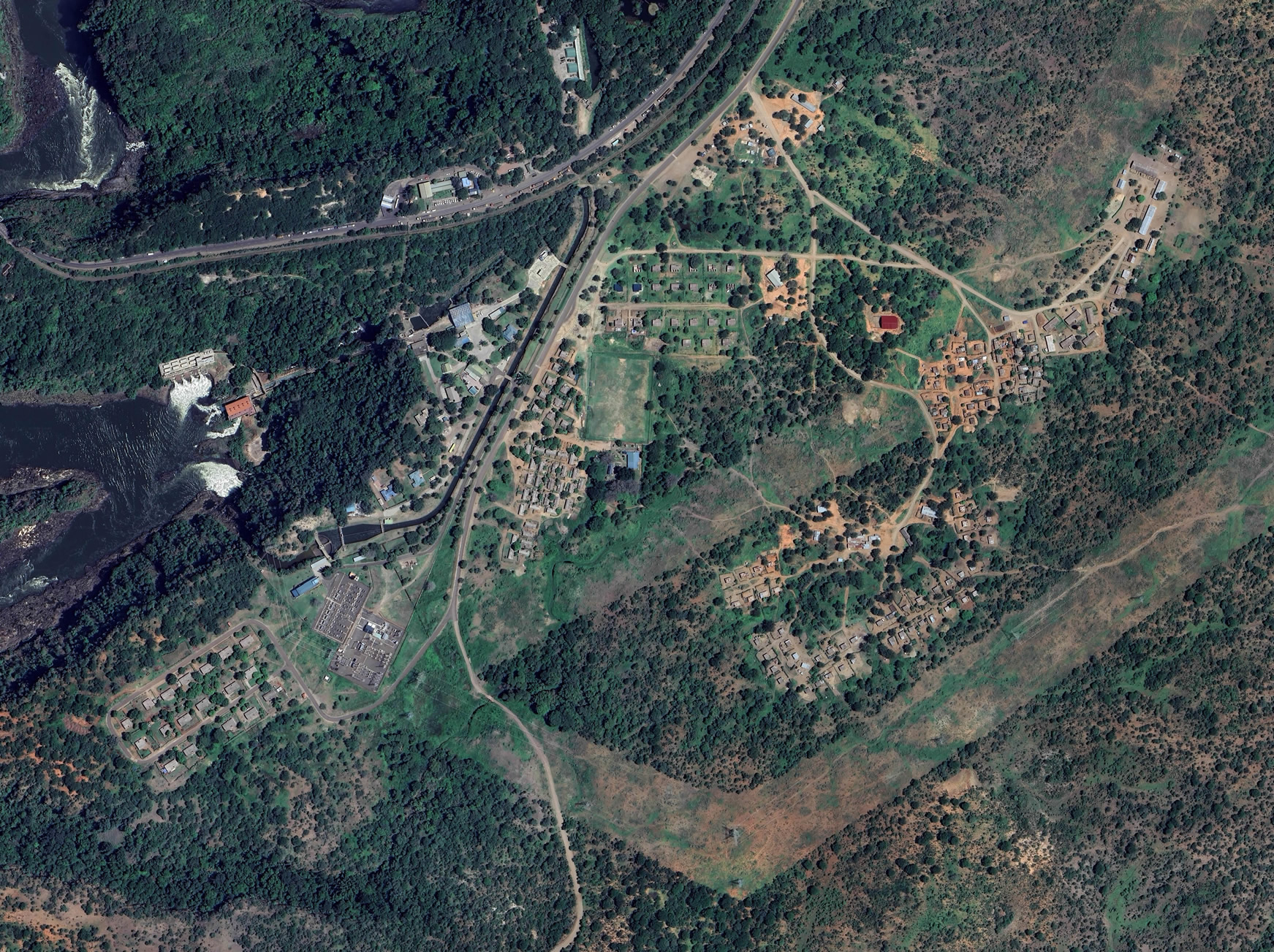
Area of ZESCO development showing original area of development (predominantly left side of image) and encroachment into Mosi-oa-Tunya National Park and World Heritage Site (predominantly om right side of image), 2025 [click for larger file]
References
Parsons, D. (1938) Harnessing the Victoria Falls. Discovery.
Roberts, P. (2025) Footsteps Through Time - A History of Travel and Tourism to the Victoria Falls. Second Edition. Zambezi Book Company / CreateSpace Independent Publishing. (First published 2017, fourth edition July 2025).
State Parties (2021) 2021-30 Strategic Environmental and Social Impact Assessment Report, Victoria Falls World Heritage Property (pdf download [9 mb], opens in a new window)
Victoria Falls Bits and Blogs (17th June 2020) Zesco sells Vic Falls land for proposed tourism ferris wheel development.