Keep Victoria Falls Wild
Conservation and Development of the Victoria Falls
Development of the Victoria Falls
Victoria Falls Casino
Airport Advances
Across the River
The Man Who Built Victoria Falls Town
The following text has been adapted (with permission) from
researched and written by Peter Roberts and published in February 2026
Development of the Victoria Falls
In the 1960s the Rhodesian Government announced a review of land tenure on the south bank of the Victoria Falls, culminating in the 1972 Land Tenure (Description of Boundaries) Notice (Rhodesia Government Notice No.1051 of 1972) and subsequent 1975 Parks and Wildlife Act resulting in the splitting of the wider Victoria Falls National Park into two areas separated by a new zone now opened up for the growth and development of the small tourist town (see Protection and Preservation).
Land use policy up to this date had effectively restricted development and protected the wider natural environment of the Victoria Falls, but the changing geopolitical landscape and Zambian independence made further infrastructure development inevitable. Victoria Falls town expanded rapidly during this period with the development of business stands and residential suburbs.
“Little further development took place until the mid 1960s when major political changes caused significant growth in the village. Until this time, the residents of Victoria Falls were primarily railway or government employees with a few individuals involved in tourism. Financial, commercial and social services for the village were provided by Livingstone. Moreover, a large proportion of the visitors to the Falls arrived via the international airport at Livingstone and the majority of the tourist facilities were provided there.” (Heath, 1977)
Victoria Falls Casino
Growing tourism levels eventually saw the construction of the Victoria Falls Casino, later known as the Makasa Sun Hotel (and more recently redevloped as The Kingdom at Victoria Falls), in 1966 on the site immediately next to the Victoria Falls Hotel.
“The modern, luxurious Casino Hotel was opened in 1966. It is air-conditioned throughout and has a bank, hairdressing salons, jewellery and other shops for the convenience of its patrons, besides a la carte restaurants serving breakfast 24 hours a day.” (Rhodesian National Tourism Board, 1967)
The casino was the first in the country and an added attraction advertised even by the Falls Hotel.
“The [Falls] hotel is still as popular as ever with a steady flow of visitors in and out almost daily. The nearby Casino continues to prove a big attraction, especially in the evening, and there are the usual stories going the rounds of people managing to hit the ‘jackpot.’” (Rhodesia Railways Magazine, November 1967)
The Casino was extended in 1969, at a cost of £175,000, with the addition of a new wing comprising 54 bedrooms and three luxury suites, after which the Hotel boasted a total of 102 bedrooms and six luxury suites all with private bathroom, shower, radio and telephone. Controversially the development broke the local skyline of the Falls, infringing a local council building requirement that no construction should be built above the tree-line, and so be visible from the river and Falls. A small section of the old trolley line down to the Falls was preserved in the grounds of the Hotel.
In a separate proposal put forward in 1968 the Railway Company applied for 4.5 acres of land to develop a tourist recreational facility including chip-and-putt golf course, bowling greens, tennis courts, a discotheque, a refreshments bar, and an amusement centre for children (later the Elephant Hills Resort).
Airport Advances
The Victoria Falls Airport was officially opened in 1967, allowing the growing town to service its own aviation arrivals and departures and avoiding the extra rigmarole of Zambian customs and immigration formalities. The new airport was built at some distance, 20 kilometres, from the Victoria Falls and the growing tourism town.
The development of the Air Rhodesia Victoria Falls, Kariba and Hwange National Park domestic air routes boosted regional tourism.
“From Johannesburg, Bulawayo, Salisbury, Kariba and Wankie, more than ten flights a week serve the new airport 15 miles [24 km] south of the Falls. Visitors from the north come via Livingstone airport, nine miles [14.5 km] north of the Falls, in Zambia. All exclusive Flame Lilly holidays starting from most centres in Southern Africa are on sale all over the world.” (Rhodesian National Tourism Board, 1967)
Despite all the new developments at the Falls, a late 1960s tourism information leaflet, produced by the Rhodesian National Tourism Board, still proudly presented the Falls as untouched by man and modern development.
“Today the Falls are almost exactly as Livingstone first saw then, unspoilt in all their grandeur. Nothing has been allowed to mar the natural beauty of the surrounding; even the disfiguring precaution of guard rails has not been permitted. As Livingstone stood, lost in wonder, so do many thousands of visitors each year.”
The town now boasted a modern Post Office and banks, including the distinctive Standard Bank building, opened in 1968. New tourist attractions included the Falls Craft Village (established in 1967), Snake Park and Curio Markets selling traditional carvings and tourism souvenirs.
“The African Craft Village is unique in its conception. It is an exact replica of a nineteenth-century Matabele kraal, representing the home of one Matabele man and his three wives. A guided tour takes about 40 minutes and is a ‘must’ for every visitor to the Victoria Falls.” (Harris, 1969)
The Falls Hotel saw another record year in 1967 with close to 22,000 visitors. The record numbers were largely credited to the new airport and growth of international and regional air travel, including Air Rhodesia’s Flame Lilly holiday packages.
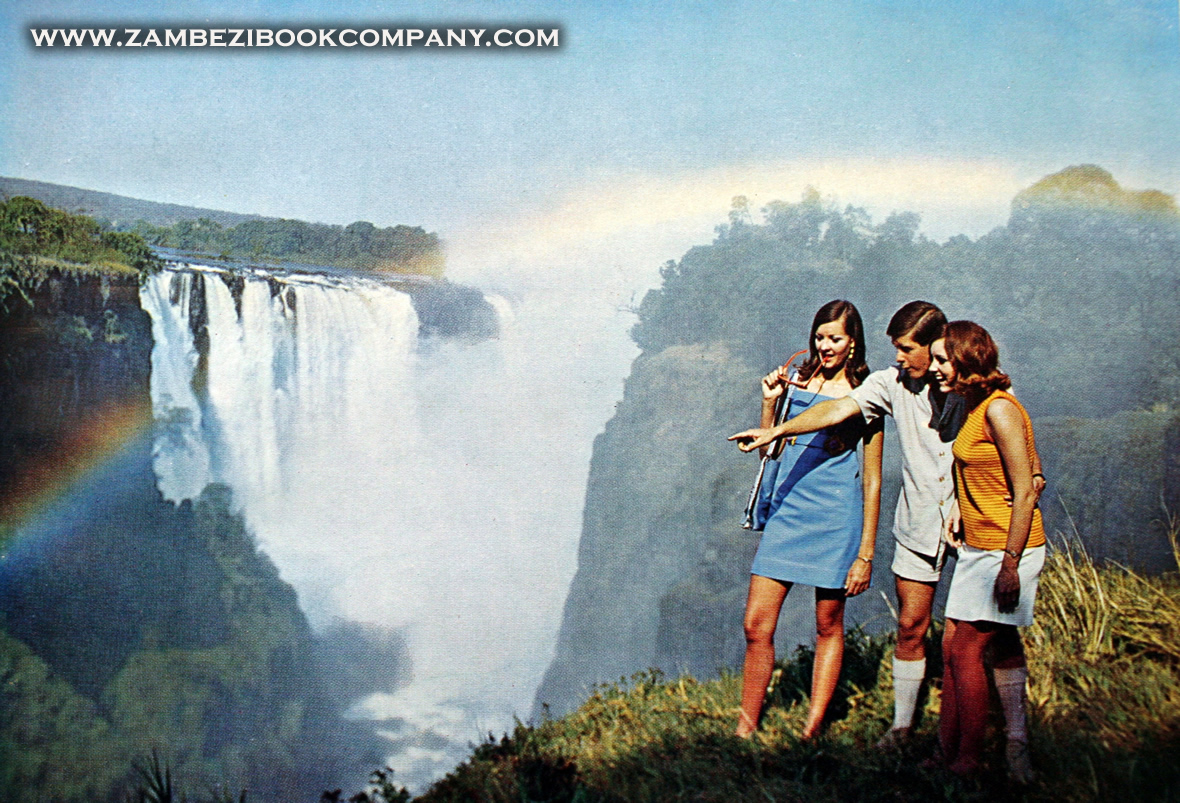
Viewing the Victoria Falls (1969)
Across the River
After decades of inviting investors to develop the site adjoining the Falls on the north bank, the Mosi-oa-Tunya InterContinental Hotel was finally opened in 1968. The hotel consisted of 95 rooms in two double-story blocks, set out at angles to the main building, housing the public areas and hotel administration. Developed by InterContinental Hotels & Resorts, part of Pan American Airways, the Hotel was operated in conjunction with the InterContinental Hotel in Lusaka. Many mourned the development of a site so close to the Falls, Teede and Teede recording:
“Lights from the Mosi-oa-Tunya Hotel in Zambia interfere with moonlight viewing of the Main Falls from Zimbabwe and have ruined the spectacular series of lunar rainbows visible over the Rainbow Falls. Any more lights and the almost transcendental experience of seeing the Falls by moonlight would be totally lost.” (Teede and Teede, 1994)
In 1969 improvements were made to the tourism infrastructure on the northern bank with the construction of the Knife-Edge Bridge. The footbridge opened up access to views of the Falls which tourists had previously struggled to reach, resulting in many minor injuries over the years.
The population of Livingstone was recorded at 49,063 in the census of 1969.
The Man Who Built Victoria Falls Town
The early seventies saw a continuing period of growth in the development of the town, with the construction of new infrastructure and tourism facilities, including housing suburbs, commercial centres, industrial premises, office and staff accommodation blocks and a diversification of new hotels. Local construction company Gardini & Sons, under the skilled guidance of Carlo Gardini, were responsible for a large percentage of the construction projects (including the previously constructed Casino and soon to be built Elephant Hills), with Carlo becoming known as ‘the man who built Victoria Falls’ (Meadows, 2000).
“Though that grand old lady of hostelries, the Victoria Falls Hotel, has been around considerably longer than Carlo ... he knows the old lady well. He has built a second storey here, added on 60 rooms there, done a major refurbishment another time. They understand each other. The Victoria Falls Casino Hotel, renamed the Makasa, the Sprayview (owned by the Gardini family), the A’Zambezi, the Rainbow, the Elephant Hills (the first small pretty version, with so much character) the Elephant Hills again (the present one that looks like Alcatraz); he built them all, with the houses, banks and shopping centres in between.” (Meadows, 2000)
The fully air-conditioned, 40-room Peter’s Motel opened in 1969 (later renamed the Victoria Falls Motel and later still the Sprayview Hotel), built, owned and operated by the Gardini family. The riverside A'Zambezi River Lodge, with 65 double and 15 family rooms, opened in 1972, and the centrally located 44-room Rainbow Hotel in 1974 - both again constructed by Gardini & Sons. The old Sprayview Restaurant was demolished in 1970. The Spencer Creek Crocodile Ranch was established in 1971, operating as both a commercial crocodile farm and tourist attraction. The ranch has grown into a major employer in the predominantly tourism based town.
In 1972 the town management board was upgraded into a Town Council, and the Victoria Falls Main Camp accommodation, camping and caravanning facilities located in the town centre were taken under the Council’s management in 1974. By the mid-1970s new visitor pathways had been developed running through the Rainforest and to the various viewpoints on the south bank.
The Elephant Hills Country Club was opened in 1974, located a short distance upstream of the Falls on the high ridge Percy Clark had named Dale’s Kopje. The four-star development included 20 rooms all with bath, phone, radio and air-conditioning. Facilities included squash courts, tennis courts, two swimming pools, bowling green, conference room, casino. and 18-hole international standard golf course designed by South African golfer Gary Player and opened in 1975.
By 1977 the town boasted six hotels offering a total of 440 rooms and assumed bed capacity of about 880 beds, in addition to the National Parks Camp facilities including 40 self-catering chalets and space for camping and caravans.
Heath, writing in the late 1970s, reflected that the growth of Victoria Falls town had followed a consistent pattern of adapting to, and following, development, rather than controlling and shaping it:
“It would be unfortunate if the trend, which has characterised the village throughout this century, of planning reflecting individual enterprise rather than guiding and controlling it, should be allowed to continue.” (Heath, 1977)
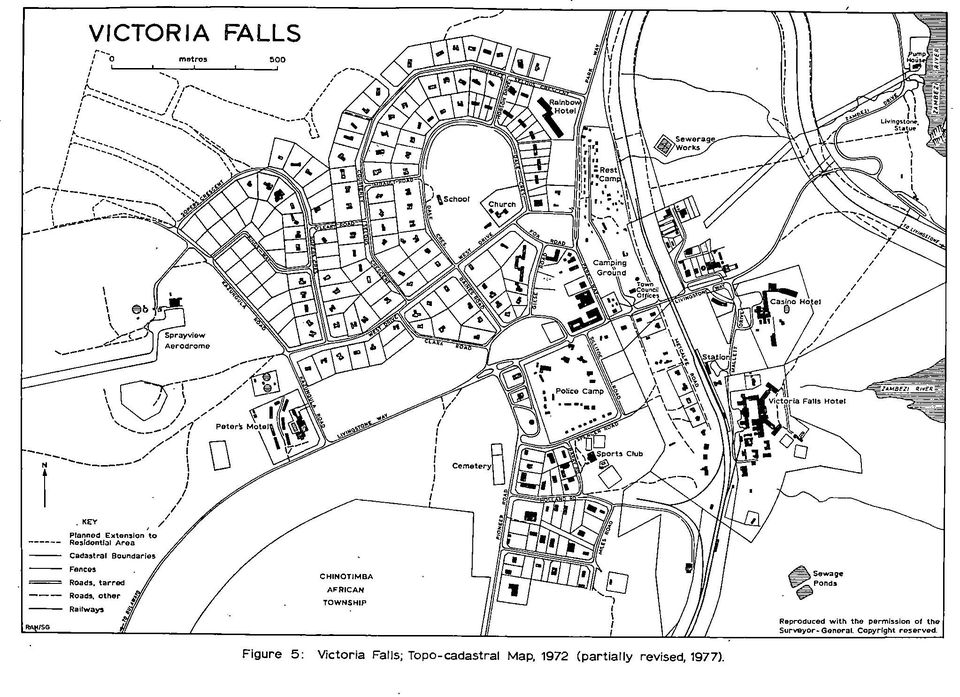
Victoria Falls town, 1977 (Heath, 1977)
Next: Victoria Falls 1975 Outline Plan
References
Links to external sites or pdf downloads, open in a new window.
Central Statistics Office (1969) Census Report, Central Statistics Office, Salisbury.
Central Statistics Office (1989) 1982 Population: Main Demographic Features of the Population of Matabeland North Province, Central Statistics Office, Harare.
Child, Heath and Moore (1989) Tourism to National Parks in Zimbabwe 1969-1989. Proceedings of the Geographical Association of Rhodesia. No.20, p53-78. [pdf]
Harris, D. (1969) Victoria Falls Souvenir Guide Book.
Heath, R. A. (1977) Victoria Falls. The Growth of a Rhodesian Village Proceedings of the Geographical Association of Rhodesia. No.10, p.15-29. [pdf]
Heath, R. A. (1986) The National Survey of Outdoor Recreation in Zimbabwe. Zambezia XII(1), p.26-36. [pdf]
Heath, R. A. (1990) The Relationship Between Domestic and International Tourism in Zimbabwe: A Case Study Of The Victoria Falls and Hwange National Parks and Lake Kariba Tourism Recreation Research, 15:1, p.7-17. [pdf]
IUCN (1996) Strategic Environmental Assessment of Developments Around Victoria Falls, Volume 1: Strategic Environmental Assessment Report. IUCN Regional Office for Southern Africa.
Meadows, K. (2000) Sometimes when it rains: white Africans in black Africa. Thorntree Press.
Makuvaza, S. (2012) Who Owns the Special Area at Victoria Falls World Heritage Site? The Historic Environment, Vol.3 No.1, April, p42-63. [pdf]
Moonga. K. (1999) The Development of Tourism in Livingstone District, 1945-1991. University of Zambia.
Phillipson, D. W. (1990) The Early History of the Town of Livingstone, in Phillipson D. W. [Editor] (1990) Mosi-oa-Tunya: a handbook to the Victoria Falls region. Salisbury: Longman, Zimbabwe. (First published 1975, Second edition 1990)
Rhodesia Railways Magazine (November 1967) District notes, Victoria Falls. Vol.16, No.7, p.41.
Rhodesian National Tourism Board (1967) Victoria Falls. Publicity brochure.
Roberts, P. (2025) Footsteps Through Time - A History of Travel and Tourism to the Victoria Falls. Second Edition. Zambezi Book Company / CreateSpace Independent Publishing. (First published 2017, fourth edition July 2025).
Roberts, P. (2026) Paradise Lost? Conservation and Development of the Victoria Falls (1900-2025). First Edition, February 2026. Zambezi Book Company / CreateSpace Independent Publishing.
Teede, J. and Teede, F. (1994) African Thunder - The Victoria Falls. Zimbabwe.
US Department of State (1964) International Boundary Study, No.15, March 1964. The Geographer Office of the Geographer Bureau of Intelligence and Research