Keep Victoria Falls Wild
Existing Developments
Mosi-oa-Tunya National Park (Zambia)
The Legacy Development (2006)
The Legacy Development (2006)
Monitoring Mission (November 2006)
Unsuitable Developments
Tourism Impacts
Development Moratorium (January 2007)
Committee Concerns (June/July 2007)
The Legacy Development (2006)
In October 2006 it was announced that the Zambian Wildlife Authority (ZAWA) had awarded a 75-year land lease to the Legacy Zambia Holdings for a major new tourism development on the north bank a short distance above the Falls. The proposed $200 million Mosi-oa-Tunya Hotel and Country Club Estate Project included two five-star hotels (with over 450 rooms), an 18-hole golf course, conference centre and a marina on a 550 acre riverside site in the Mosi-oa-Tunya National Park, including an area within the World Heritage Site.
A foundation stone for the development was unveiled by Vice-President Lupando Mwape on 29th July 2006. Details of the development were disclosed at a National Park stakeholder meeting held in September 2006.
“After questions it was revealed that Tourism Investments Ltd (Zambia) had originally applied for a small plot of land along the Zambezi just north of Maramba River mouth and south of the ‘Common Marina’. This plot had been advertised and apparently covered 4 hectares. After winning the tender the company requested for more land, since their proposed development would not fit within the 4 ha. They were granted more. They then went into partnership with Legacy Group of South Africa. Legacy expanded the project idea and demanded for more extensions to the land. These demands were made through higher offices in government and ZAWA was forced to grant it to them. ZAWA were then invited to a ceremony for the unveiling of the foundation stone to be done by the President of the Republic.” (Mateke, 2006)
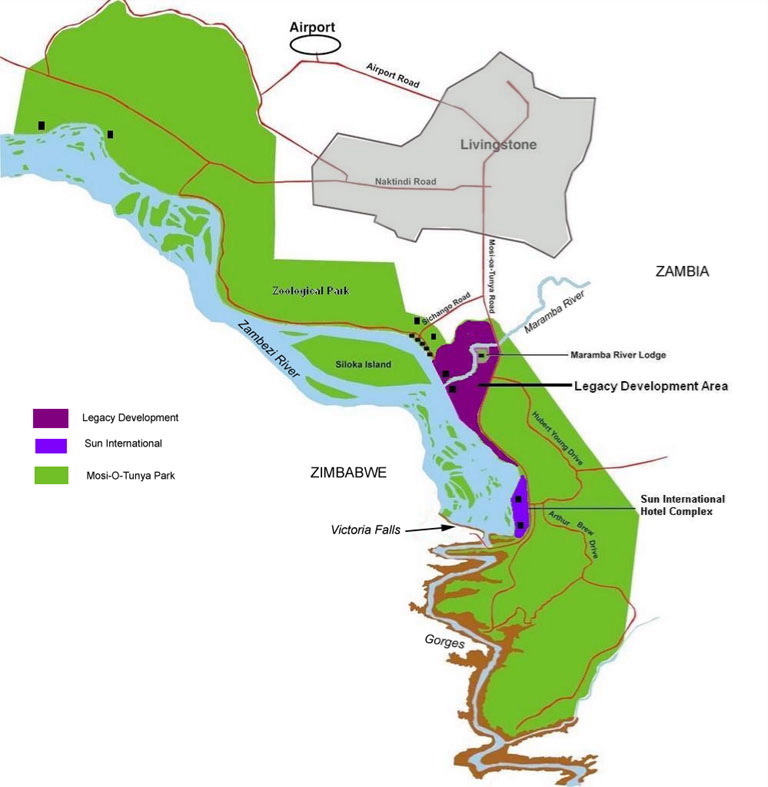
Location of the proposed Legacy Development, Mosi-oa-Tunya National Park.
[click for larger view]
The plans were criticised by local residents, tourism operators and conservationists. Nicholas Katanekwa, chair of the Livingstone Tourism Association, recorded:
“We have benefited so much from the booming tourism here but we may lose out, as UNESCO (the United Nation’s cultural agency) has already indicated to us plans of withdrawing the status of Victoria Falls as a World Heritage Site, should the construction of a Legacy Hotel be allowed to go on in the park.” (Victoria Falls Bits and Blogs, 15th November 2006)
The proposals led to calls for a boycott of Legacy Resorts & Hotels International and articles in the international media (The Times, 2nd December; The Sunday Times, 3rd December 2006). The controversial development was even reported in National Geographic Magazine in January 2007.
“Showdown at the Victoria Falls - Just before the Zambezi River makes its famous plunge, lies a small, undeveloped stretch of Zambia’s Mosi-Oa-Tunya National Park. It’s a crucial elephant crossing and the sole riverfront spot in the park that people can enjoy without paying a fee. South African developer, Legacy Holdings Zambia, with the support of the Zambia Wildlife Authority, has different plans for the site: two hotels, 400 villas, and a golf course. In a nod to wildlife, the plans include an elephant right-of-way flanking the Maramba River. Critics find this laughable. ‘Elephant corridors have never worked anywhere,’ says conservationist, Mike Musgrave. Since the proposal became public last summer, Zambians ranging from local government officials to a bike-tour guide have rallied in opposition. Area residents welcome development, just not so close to the Falls that it jeopardises the park’s status as a UNESCO World Heritage Site. They hope grassroots pressure and a legal challenge will save the park’s last riverfront open space. ‘Even 30 years ago Victoria Falls was overdeveloped,’ says Ian Manning, a former park warden. ‘This would be a disaster.’” (National Geographic, January 2007)
The proposal appears to have divided local residents, with Chief Mukuni supporting the proposals.
“‘To us the Legacy Holdings project is an equivalent of Lumwana mine in Solwezi. Our friends in other places have benefited from the mining investment and you cannot take tourism away from us,’ Chief Mukuni said. ‘The people in the chiefdom are determined to see the Legacy Holdings project coming to fruition.’” (Victoria Falls Heritage Blogspot, 1st January 2007)
A representative of the the Chief also recorded:
“The resort’s promise of creating 2,000 jobs has elicited strong support for the project among local residents and organisations. ‘We, the people of Livingstone, want development. We want Legacy because we have suffered too much with joblessness and poverty,’ said Shadrick Mabote, a representative of senior chief Mukuni, in whose chiefdom the Victoria Falls is located. ‘We are ready to take any action against those opposing the project, and we can even walk up to State House in protest if anything is done to disturb Legacy from constructing the project in this land.’ (Victoria Falls Bits and Blogs, 15th December 2006)
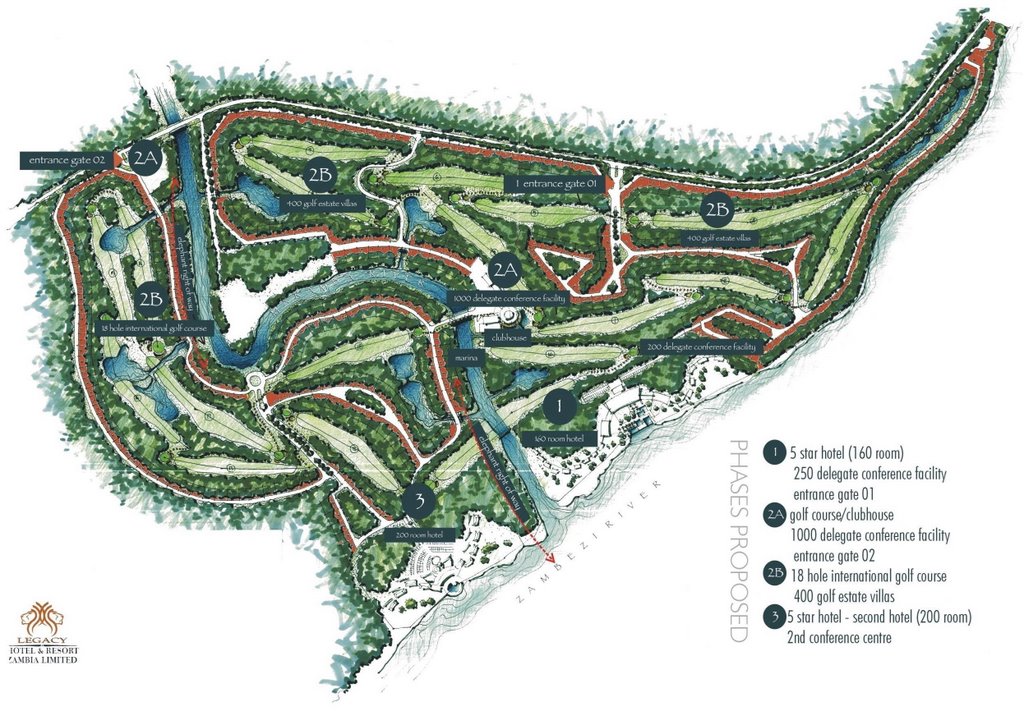
Plans for the Legacy Development, Mosi-oa-Tunya National Park. [click for larger view]
Monitoring Mission (November 2006)
Proposals for a north bank tethered observation balloon, construction of which had started at a site within the ZESCO service area supporting the Hydro-electric station immediately below the Falls, together the Legacy development plans stimulated a UNESCO Reactive Monitoring Mission to investigate the proposed developments. The Mission visited the Falls from 20th-25th November 2006.
The final Mission Report summary detailed several key recommendations:
“The mission concludes that a series of urgent actions need to be taken by the two State Parties of Zambia and Zimbabwe to ensure that outstanding universal values of the site are not compromised and effective conservation is assured. The key recommendations of the mission are as follows:
i) Establish a Joint Ministerial Committee (including appropriate technical sub-committees) for effective transboundary coordination.
ii) Develop a Joint/Integrated Management Plan for the World Heritage site by May 2007, and secure necessary approvals and funding for its implementation.
iii) All issues related to development of infrastructure, tourism facilities and services, eradication of invasive species, control of pollution, abstraction of water from the Zambezi, etc should be fully considered and addressed in the Joint Management Plan, consistent with the recommendations of the 2002 bilateral workshop.
iv) Pending action by the two State Parties on these points, there should be a complete moratorium on the construction and development of all tourism infrastructure, facilities or services within the World Heritage property.
v) Zambia should not proceed with the development of the Mosi-oa-Tunya Hotel and Country Club Estate project along the bank of the Zambezi River within the World Heritage site, as currently planned. The World Heritage Committee should consider inscribing the site on the World Heritage in Danger List, if the project is approved for implementation.
vi) Zambia should also reconsider the project under implementation to erect a tethered balloon as it will adversely impact the visual integrity of the site, because when raised the balloon is likely to appear within the viewing corridor of the falls.
vii) The two countries should develop specific benchmarks and indicators, with reference to the statement of significance of the site, which can be assessed during the process of monitoring its State of Conservation and better address management and protection concerns of the site.” (World Heritage Commission, 2007)
The report highlighted four main threats to the natural values of the site:
“i) The growing tourism infrastructure development and provision of visitor services:
ii) The abstraction of water from the Zambezi River, upstream of the Victoria Falls and its impact on the extent of the falls, particularly during the dry season:
iii) Pollution, in particular sewage pollution from Livingstone, which reportedly goes into the Maramba River (although this was contested by a member of the Zambian Environment Council);
iv) The anticipated destruction of the natural riparian vegetation by the proposed development of a 5-star hotel, golf course estate and conference facility on the Zambian side of the Zambezi River.
“Moreover, there is no mechanism in place to systematically monitor all these critical factors and assess their impacts on the values of the property.” (World Heritage Commission, 2007)
Unsuitable Developments
The report also identified that several tourism developments had apparently been developed within the area of the World Heritage Site, although details of these developments appear to have been lacking, despite a specific request to both State Parties for further information.
“It is clear that since inscription of the property on the World Heritage List in 1989, a number of hotels and resorts have been developed, or old ones renovated and expanded, within the boundaries of the inscribed property on either side of the Zambezi. However, the Mission was not able to secure any details or maps on site to clearly explain these developments.”
The report went on to clarify that tourism developments should not be allowed within the area of the WHS, while referring to the recommendations of the 2002 Bilateral Workshop.
“It is not desirable for the hotels and resorts to be developed within the World Heritage property, considering the small size of the inscribed area and such facilities could be easily located at some distance from it so that the possibilities of adverse impacts are minimised. Moreover, the 2002 bilateral workshop had made very specific recommendations on all aspects of sustainable development and management of the property, including details of total number of hotel beds and hotel area that could be developed in both countries, but these were not being followed and hence, the continuing concern expressed by the World Heritage Committee.” (World Heritage Commission, 2007)
Tourism Impacts
The report highlighted increasing tourism development impacts at the Falls.
“The growth of tourism facilities and services is a cause for concern. The noise of helicopters flying overhead is almost constantly heard. The mission not only saw many helicopters operating over the Falls, but also the equally noisy microlight aircraft...
“At a given point in time the mission saw at least a dozen cruise boats operating along a relatively short stretch of the Zambezi, just upstream from the Falls. The Zimbabwean authorities reported that there are 20 boarding points along the shoreline and about 40 cruise boats, but that not all of them are currently operational. For Zambia 4 jetties are reportedly licensed to operate river cruises. The mission also witnessed a jet-boat moving at great speed and with very loud noise along this stretch of the river, very close to where a family of hippopotamus were visible. The need for such a facility for the tourists, which could endanger the native wildlife and adds to the noise pollution, is very questionable. Similarly, extreme sport facilities like bungee jumping, gorge swing, abseil, and flying fox are being offered within the property, which also do not seem appropriate within the World Heritage context and in maintaining the aesthetic qualities of the property...
“The property is also inscribed under criteria (vii) and the various visitor facilities like hotels, helicopters and other aircraft, cruise and jet boats, balloon, etc undoubtedly have a negative impact on its outstanding universal value of ‘exceptional natural beauty and aesthetic importance’ and disturb its visual integrity and hence, there is an urgent need to review and regulate these facilities and services.” (World Heritage Commission, 2007, p.5-6)
As part of the review the mission requested information on the “number of helicopters and other aircraft, as well as cruise boats and jet boats that have been licensed to operate at the site.” Zimbabwe reported 37 registered boats and “an average 20 helicopter flights per day,” while Zambia recorded “10 boats and 4 helicopters licensed” (World Heritage Commission, 2007).
The report included the first detailed map of the WHS boundary, produced by the African Wildlife Foundation and dated 2006 (World Heritage Commission, 2007)
Development Moratorium (January 2007)
A moratorium on development within and surrounding the World Heritage Site was subsequently requested by UNESCO, pending agreement and implementation of a joint management plan for the site between the two State Parties, agreed in 2002 but yet to be drafted. The moratorium was implemented on both sides of the river in January 2007. Media reports quoted Dr Mutsambiwa, Zimbabwe National Park Authority Director-General reflecting:
“This plan was supposed to have been in place before Zambia had started building a hot air balloon base and a 500-bed lodge. We were also expected to monitor all activities on our side and some developments were overlooked. We were very much concerned because this meant that the tourist attraction could be de-listed from its World Heritage Status. This would be a shame to us because we presented this area as deserving such a status. To try and regain that status, if it happens that we lose it, would actually be almost impossible.” (Victoria Falls Bits and Blogs, 24th January 2007)
The moratorium suspended development of two north-bank riverside lodge developments, the David Livingstone Safari Lodge (2008) and Toka Leya Camp (2008), both of which appear to have opened in 2008 after agreement of the 2007 Joint Plan for the Site and lifting of the moratorium.
Committee Concerns (June/July 2007)
At the 31st session of the World Heritage Committee (31COM), held in Christchurch, New Zealand in June/July 2007, a summary of the conservation issues facing the World Heritage Site recorded:
“As requested by the Committee at its 30th session (Vilnius, 2006), the World Heritage Centre and IUCN conducted a monitoring mission to the property in November 2006 in cooperation with both State Parties in Zambia and Zimbabwe. The mission found that continuing developmental pressures within and adjacent to the property are adversely impacting on its values and integrity, mainly as a result of failure to implement recommendations made in the past Committee decisions for effective management.
“In the reports submitted in January 2007, both State Parties identified the lack of Joint Management Framework and Joint Management Plan, as well as the lack of implementation of the recommendations of the 2002 Bi-national workshop as the main management obstacles for conservation of the property.
“The State Party reports and the 2006 Monitoring Mission confirmed that unplanned tourism development continues to affect the integrity of the property. This has also been the topic of several recent media reports.
“Key issues identified by the Monitoring Mission and State Party reports include:
a) Unplanned tourism development - The report by the State Party of Zimbabwe has identified tourism development as a factor which affects to to the loss of wilderness and aesthetic value on the property. The report of Zambia also identified development pressures to include, specifically, the plan for a hotel and country club, and the highflier balloon in the North East of the property, 3 km from the Falls.
“The Mission raised serious concerns with Zambia about the Mosi-oa-Tunya Hotel and Country Club Estate project. The project is anticipated to not only destroy the riparian vegetation, but also interfere with the catchment function and wild animal movement, and contribute to the pollution load of the river, thus, adversely impacting on the Outstanding Universal Value and integrity of the property. According to media reports in December 2006, Zambia has reconsidered the project due to concerns of negative impact on the property. The World Heritage Centre and IUCN continue to have concerns about the project and would welcome further information from the State Party as to its current status.
b) Visitor carrying capacity of the property - Both State Party reports confirm that visitor numbers are growing and note that increasing visitor numbers is part of their policy. The World Heritage Centre and IUCN observed during the mission that high visitor rates are causing noise pollution from helicopters, microlight aircraft, and boats. In addition, aquatic wildlife is constantly disturbed by riparian activities.
“The Mission also noted that the Civil Aviation Authority of Zimbabwe is currently expanding the Victoria Falls Airport and the authorities anticipate increased visitor numbers, particularly with the 2010 Football World Cup in South Africa. Also, the Zambian government has prioritized tourism as a key economic growth sector, as is evident from the proposed hotel and golf complex project. The expected increase in visitors necessitates the rapid establishment of a Joint Ministerial Committee so that the State Parties can incorporate management of carrying capacity in the Joint Management Framework and Plan.
c) Ecological priorities for the Joint Management Plan - Both the State Parties reports and the Monitoring Mission highlighted additional factors affecting the property that need to be addressed by the Joint Management Plan.” (UNESCO 2007)
Additional ecological priorities were highlighted, including fragmentation of habitat and blocking of wildlife movement through fencing:
“Fragmentation of the habitat as a result of fencing, development, deforestation and grazing, leading to increased human-wildlife conflicts, in particular by blocking elephant corridors.” (UNESCO 2007)
The report also highlighted developing joint initiatives and the urgent need for a joint management plan for the site.
“The two State Parties have joined the Kavango-Zambezi Transfrontier Conservation Area that promotes integrated river basin management. Bilateral meetings and joint operations at site level are being periodically carried out.
“The Zambian State Party expects to form a National Committee on World Heritage issues by March 2007. It is also using the 1996 Strategic Environmental Assessment guidelines in the control of developments in the property and has signed a MOU between National Heritage Conservation Commission and Zambia Wildlife Authority to harmonize conservation and development imperatives in the property.
“The Joint Monitoring Mission concludes that a series of urgent actions should be undertaken, particularly the ‘Development of a Joint / Integrated Management Plan for the World Heritage property.’ The State Party of Zimbabwe (with support from Zambia) had submitted an International assistance request to the World Heritage Centre, for an amount of USD 30,000, to implement this recommendation. The request was approved...
“The World Heritage Centre and IUCN sent an international consultant to liaise and support the State Parties in the preparation of the Joint Integrated Management Plan for the property. The Draft management plan is expected to be finalized by May 2007, before the 31st session of the Committee.” (UNESCO 2007)
References
Mateke, C. (2006) Notes on Zambia Wildlife Authority (ZAWA) Stakeholders’ Workshop on the Preparation of the General Management Plan for Mosi-oa-Tunya National Park, 11-15 September 2006, New Fairmount Hotel, Livingstone. victoriafallsheritage.blogspot.com.
National Geographic (January 2007) Showdown at the Victoria Falls.
Roberts, P. (2025) Footsteps Through Time - A History of Travel and Tourism to the Victoria Falls. Second Edition. Zambezi Book Company / CreateSpace Independent Publishing. (First published 2017, fourth edition July 2025).
The Sunday Times (3rd December 2006) Golf resort hits rough.
The Times (2nd December 2006) Victoria Falls hotel fury.
UNESCO (2007) Conservation issues.
Victoria Falls Bits and Blogs (20th October 2006) Furore erupts over Vic Falls tourism project.
Victoria Falls Bits and Blogs (15th November 2006) Victoria Falls could lose World Heritage status.
Victoria Falls Bits and Blogs (15th December 2006) Concerns mount over World Heritage Site status.
Victoria Falls Bits and Blogs (8th January 2007) Victoria Falls ‘at risk’, UN warns.
Victoria Falls Bits and Blogs (24th January 2007) Vic Falls Projects Frozen.
Victoria Falls Bits and Blogs (25th January 2007) Zimbabwe: Don’t Turn Victoria Falls Into Concrete Jungle.
Victoria Falls Bits and Blogs (22nd March 2007) In Zambia, battle over future of Victoria Falls.
Victoria Falls Heritage Blogspot (1st January 2007) Chief Mukuni Supports Legacy, (quoting unreferenced newspaper article).
World Heritage Committee (2007) Decisions Adopted, 31COM 7B.4.